No. 04  ·  Treatments

Procedures designed to be quiet.

All performed in-office, under local anesthesia, in under an hour. There's no hospital, no general anesthesia, and — for most treatments — no downtime. The right approach is chosen for your anatomy under ultrasound, not from a fixed menu.

01RFA
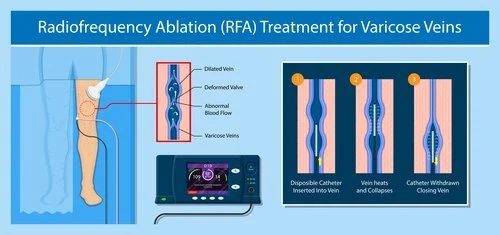
Radiofrequency ablation of a vein under ultrasound guidance.

Radiofrequency Ablation

A tiny catheter, real-time ultrasound, gentle heat.

A tiny catheter is guided into the failed vein under real-time ultrasound, and radiofrequency heat is applied to collapse the vein closed. The body re-routes circulation to healthy veins. The whole procedure takes less than an hour and is done in the office under local anesthesia — the workhorse treatment for larger refluxing veins.

Procedure profile

  • Duration · under 1 hour
  • Anesthesia · Local, in-office
  • Downtime · Minimal — back to your day
  • Best for · Larger refluxing saphenous veins

What recovery looks like

  • Walking encouraged immediately
  • Compression hose for a short period
  • Most resume normal activity right away
  • Follow-up ultrasound to confirm closure
02VenaSeal
VenaSeal medical-adhesive vein closure being performed.

VenaSeal™ Closure

A non-thermal, non-tumescent adhesive option.

A medical-grade adhesive is injected into the diseased vein to glue it permanently closed. There's no heat and no tumescent anesthesia, which means minimal bruising. It's an office-based procedure that takes about 30 minutes.

Procedure profile

  • Duration · ≈ 30 minutes
  • Anesthesia · Local at access point
  • Downtime · Same-day return to activity

Considered for

  • Patients preferring no thermal energy
  • Anatomy favoring adhesive closure
Discussed during consultation based on your anatomy and insurance coverage.
03Varithena
Varithena microfoam injected into a vein.

Varithena®

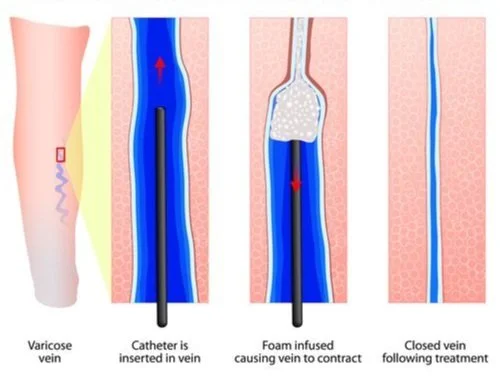
FDA-approved microfoam for tortuous, hard-to-reach veins.

Varithena is an FDA-approved microfoam medication injected directly into diseased veins, causing them to collapse and break down. It's especially useful in areas where a radiofrequency catheter can't be applied — winding tributaries and irregular anatomy.

Procedure profile

  • Duration · ≈ 30 minutes
  • Anesthesia · Local at injection site
  • Downtime · Short. Walking afterward.

Best suited for

  • Tributary & tortuous veins
  • Anatomy not ideal for a catheter
  • Patients seeking non-thermal options
04Foam Sclerotherapy
Ultrasound-guided foam sclerotherapy preparation.

Ultrasound-Guided Foam Sclerotherapy

Foam, placed precisely under ultrasound.

A detergent solution in foam form is injected via a fine needle, under ultrasound visualization, to scar and close varicose veins that sit below the skin surface. Ultrasound guidance is what lets us reach and treat veins that can't be seen by eye.

Procedure profile

  • Duration · 20–30 minutes
  • Anesthesia · None to minimal
  • Downtime · Compression hose, no walking restriction

Best suited for

  • Below-surface varicose veins
  • Branches feeding larger vessels
  • Residual veins after ablation
05Visual Sclerotherapy
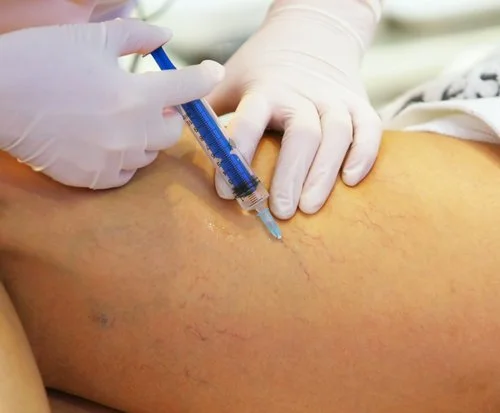
Visually guided injection of surface spider veins.

Visually Guided Sclerotherapy

Tiny injections to fade cosmetic spider veins.

A tiny needle delivers a sclerosant directly into cosmetic spider veins at the skin's surface. The vessel wall reacts, collapses, and the body reabsorbs it over several weeks. We always check for underlying reflux first — treating the surface alone, while the deeper cause remains, simply invites the spider veins back.

Procedure profile

  • Duration · 15–30 minutes
  • Anesthesia · None required
  • Downtime · None — walk out and resume your day

Best suited for

  • Cosmetic surface spider veins
  • Small surface varicosities
06Compression

Conservative & Compression Care

Not every leg needs a procedure.

For many patients, the right combination of graduated compression hosiery, weight and activity changes, and supportive care is enough — or it's the right starting point before considering anything more invasive. Many insurance plans also require a trial of conservative care first, and we'll guide you through it honestly.

What's involved

  • Graduated compression hose
  • Activity and weight guidance
  • Periodic re-evaluation

Right for

  • Mild venous symptoms
  • Pre-procedure preparation
  • Post-procedure recovery

The right treatment is chosen — never assumed.

The screening doesn't commit you to anything. It lets Dr. Aleman see what he's working with — and you decide from there.